
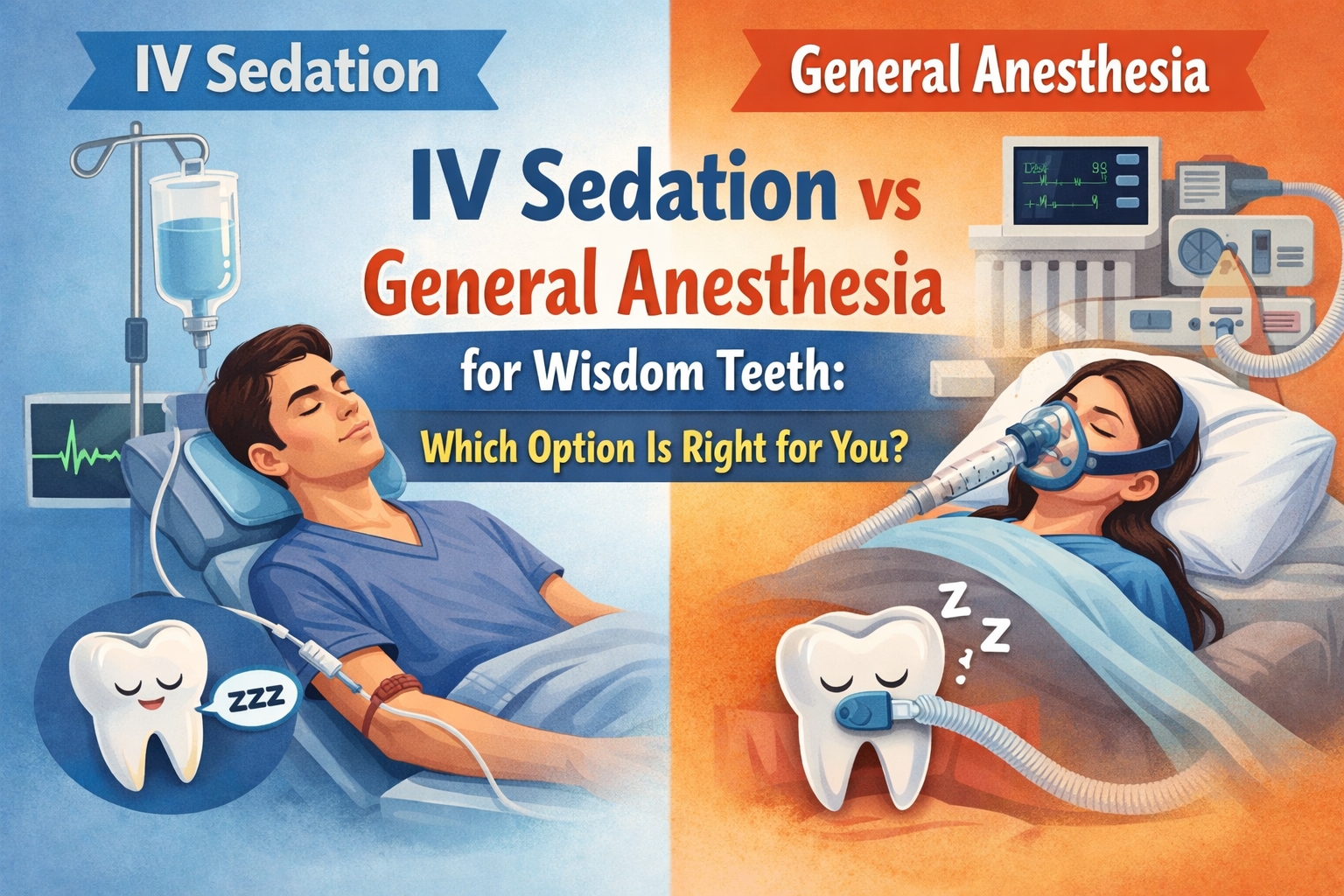
Getting your wisdom teeth removed is practically a rite of passage—but that doesn’t mean you need to be awake and anxious while it happens. If you’re facing wisdom tooth extraction, one of the biggest decisions you’ll make is choosing between IV sedation and general anesthesia. Both options can make your procedure comfortable and pain-free, but they work in very different ways.
Let’s clear up the confusion and help you understand which sedation method makes the most sense for your wisdom teeth removal.
Understanding the Difference: It’s All About Consciousness
Here’s the simplest way to think about it: consciousness during a medical procedure exists on a spectrum. At one end, you’re completely awake and aware of everything happening. At the other end, you’re under general anesthesia—completely unconscious, unresponsive, and with zero memory of the experience.
IV sedation lives somewhere in the middle of that spectrum, offering deep relaxation and amnesia while you remain technically conscious. For wisdom teeth removal, both options can work beautifully—the question is which one fits your needs, preferences, and medical situation best.
And here’s one thing both have in common: you’ll absolutely need someone to drive you home afterward. No getting around that one!
IV Sedation for Wisdom Teeth: The Popular Middle Ground
IV sedation has become the go-to choice for wisdom teeth removal, and for good reason. It delivers medication directly into your bloodstream through a vein, which means it works almost instantly and can be adjusted throughout your procedure.
What Happens During IV Sedation?
When you receive IV sedation for your wisdom teeth extraction, you enter what many call a “twilight” state. You’re technically conscious and might even be able to respond if your oral surgeon asks you to open your mouth wider or turn your head. But here’s the beautiful part: you’ll be completely unaware of your surroundings and won’t remember anything about the procedure.
Think of it like this—it’s as if someone hit the fast-forward button on your life. One moment you’re settling into the chair, the next moment you’re being gently awakened and told it’s all done. The entire procedure just… disappears from your memory.
Why Dentists Love IV Sedation for Wisdom Teeth
For wisdom tooth extractions specifically, IV sedation offers some compelling advantages:
It works immediately. No waiting 30-60 minutes for a pill to kick in while you sit there getting more nervous. The medication enters your bloodstream and takes effect within seconds.
It’s adjustable on the fly. If your extraction is more complex than expected, your oral surgeon can increase the sedation level. If things are wrapping up quickly, they can ease off. This flexibility is especially valuable for wisdom teeth, where the complexity can vary significantly from patient to patient.
You avoid general anesthesia risks. Since you remain conscious (even if deeply sedated), you continue breathing on your own. You don’t need a breathing tube, and you avoid some of the risks and longer recovery time associated with general anesthesia.
Recovery is relatively quick. Most people feel groggy for a few hours after IV sedation, but you’re not dealing with the extended recovery period that comes with general anesthesia.
It’s highly effective for anxiety. Let’s be honest—wisdom teeth removal can be intimidating. IV sedation eliminates that anxiety completely. You won’t feel nervous because you won’t be mentally present for the experience.
The IV Sedation Experience: What to Actually Expect
On the day of your procedure, you’ll arrive at the oral surgery office having fasted for at least 8 hours (no food or drinks—yes, even water). Your oral surgeon will place a small IV line in your arm or hand, which feels similar to getting blood drawn.
Within moments of receiving the medication, you’ll start feeling extremely relaxed. Your eyelids will get heavy. The room might start feeling a bit dreamy. And then… nothing. The next thing you know, someone is gently calling your name and telling you it’s time to go home.
The actual surgery typically takes just 15-30 minutes when performed under IV sedation, partly because you’re so relaxed that the surgeon can work efficiently, and partly because experienced oral surgeons work quickly.
Who Is IV Sedation Perfect For?
IV sedation works beautifully for most patients having their wisdom teeth removed. It’s especially ideal if you:
- Have moderate to severe dental anxiety
- Are having multiple wisdom teeth extracted at once
- Have impacted wisdom teeth that require more complex surgical removal
- Want to have zero memory of the procedure
- Prefer to avoid the risks and recovery time of general anesthesia
- Are generally healthy without major medical complications
General Anesthesia for Wisdom Teeth: When Complete Unconsciousness Makes Sense
General anesthesia takes sedation to its deepest level. You’re not just relaxed or in a twilight state—you’re completely unconscious and unresponsive. It’s the same type of anesthesia used for major surgeries, though for wisdom teeth it’s typically administered without the breathing tube you’d need for a longer hospital procedure.
How General Anesthesia Works
For wisdom teeth removal, general anesthesia usually involves a combination of IV medications (often including Propofol) and sometimes inhaled gases. You’re completely “asleep”—not the natural sleep you experience at night, but a medically induced state of unconsciousness where you can’t be easily awakened until the medication wears off.
The key difference from IV sedation? With general anesthesia, you have absolutely no chance of being aware during the procedure. You’re as “out” as it’s possible to be while still breathing on your own.
When General Anesthesia Becomes the Better Choice
While IV sedation works wonderfully for most wisdom teeth extractions, there are specific situations where general anesthesia makes more sense:
High medication tolerance. Some patients have built up a tolerance to sedation medications due to regular use of certain prescriptions or other factors. If you’ve had IV sedation before and found it wasn’t effective enough, general anesthesia might be your better bet.
Extreme dental anxiety or phobia. If the mere thought of being even partially conscious during the procedure causes significant distress, general anesthesia provides the ultimate peace of mind. You’ll be completely unaware from start to finish.
Complex extractions. When all four wisdom teeth are severely impacted, positioned at difficult angles, or partially erupted, the surgery can take longer and be more invasive. General anesthesia ensures you remain completely comfortable throughout a more extensive procedure.
Young patients. Children under 12 who need wisdom teeth removed (yes, it happens!) are typically better candidates for general anesthesia administered by an anesthesiologist. The deeper sedation helps ensure they remain completely still and comfortable.
Certain disabilities or behavioral challenges. For patients who have difficulty remaining still, following instructions, or who have conditions that make cooperation challenging, general anesthesia can be the safer and more humane option.
Strong gag reflex or difficulty keeping mouth open. Some patients have such a strong gag reflex or jaw tension that even deep IV sedation doesn’t fully relax them. General anesthesia eliminates these issues completely.
The General Anesthesia Experience
The process starts similarly to IV sedation—you’ll fast beforehand and arrive with a designated driver. An IV line is placed, and you’ll receive the anesthesia medications. You’ll drift off within seconds.
The major difference comes in recovery. General anesthesia typically requires a longer recovery period—several hours for the effects to fully wear off, compared to the quicker bounce-back from IV sedation. You’ll likely feel groggier for longer, and you’ll need to take it very easy for the rest of the day.
The Cost Factor: Is There Really a Big Difference?
Here’s something that surprises many patients: the cost difference between IV sedation and general anesthesia for wisdom teeth removal isn’t as dramatic as you might think, especially when you’re working with an experienced oral surgeon.
For the removal of four impacted wisdom teeth, here’s what you might expect:
- IV moderate sedation (twilight sleep): $150-800
- IV deep sedation: $250-400 at specialized centers (billing based on surgical time, not recovery time)
- General anesthesia at an oral surgeon’s office: $500-1,500
The range in pricing often depends more on your location, the complexity of your case, and your insurance coverage than on the type of sedation itself. In many cases, the difference between being moderately sedated and deeply sedated or under general anesthesia is only $170-300.
Given the relatively small cost difference, the decision really comes down to your medical needs, personal preferences, and your oral surgeon’s recommendation rather than budget concerns.
IV Deep Sedation: The Best of Both Worlds?
Many modern oral surgery practices offer what’s called “IV deep sedation” or sometimes “IV deep sedation/general anesthesia” for wisdom teeth removal. This approach has become increasingly popular because it combines the benefits of both methods.
What Makes Deep Sedation Special
With IV deep sedation, you’re sedated to a level that borders on general anesthesia. You’re completely unaware, feel nothing, and remember nothing. However, you continue breathing on your own throughout the procedure without needing a breathing tube.
The key advantage? When a Certified Registered Nurse Anesthetist (CRNA) handles your sedation while the oral surgeon focuses solely on removing your wisdom teeth, you get two specialists working together. The CRNA monitors your vital signs, adjusts your sedation level, and manages any side effects, while the surgeon concentrates entirely on your teeth.
This separation of responsibilities is a significant safety advantage. You’re not relying on one person to do two complex jobs simultaneously.
The Medication Behind Deep Sedation
The primary medication used for IV deep sedation is Propofol—the same drug used in hospital settings for general anesthesia. Depending on your individual needs and medical history, your CRNA might also use Ketamine or Dexmedetomidine in combination with Propofol.
These medications work incredibly quickly (we’re talking seconds, not minutes), and recovery tends to be faster than with traditional general anesthesia. Most patients wake up relatively quickly once the procedure is complete and can go home within an hour or so.
Safety Considerations: What You Need to Know
Both IV sedation and general anesthesia are extremely safe when administered by trained professionals—and oral surgeons receive extensive training in both. We’re talking at least four years of hospital residency learning how to evaluate, deliver, and monitor patients under anesthesia. This level of training gives oral surgeons one of the best safety records in anesthesia administration, second only to anesthesiologists themselves.
Who Might Need Extra Caution with General Anesthesia
While general anesthesia is generally safe, certain medical conditions require extra consideration:
- Obesity
- Smoking
- Diabetes
- Drug allergies
- History of seizures
- Obstructive sleep apnea
If you have any of these conditions, it doesn’t necessarily mean you can’t have general anesthesia—it just means your oral surgeon and anesthesia provider will take extra precautions and might recommend IV sedation as a safer alternative.
The Importance of Honest Medical History
Here’s something crucial: be completely honest with your oral surgeon about your medical history, medications, and any recreational drug use. This information isn’t about judgment—it’s about keeping you safe. Certain medications and substances can interact dangerously with anesthesia, and your anesthesia provider needs to know everything to choose the right medications and dosages.
Making Your Decision: Questions to Ask Yourself
Still not sure which option is right for your wisdom teeth removal? Consider these questions:
How anxious are you about the procedure?
If you have moderate anxiety, IV sedation is probably perfect. If you have severe dental phobia, general anesthesia or deep sedation might give you better peace of mind.
How complex is your case?
Simple erupted wisdom teeth might only need moderate IV sedation, while severely impacted teeth might warrant deeper sedation or general anesthesia.
What’s your medical history like?
Conditions like sleep apnea might make IV sedation the safer choice over general anesthesia.
How do you typically respond to medications?
If you have a high tolerance to sedatives or pain medications, mention this to your oral surgeon—you might need general anesthesia to ensure adequate sedation.
What does your oral surgeon recommend?
Your surgeon has seen thousands of wisdom teeth extractions and can assess your specific situation. Their recommendation carries a lot of weight.
How quickly do you need to recover?
If you absolutely must be functional by the next day, IV sedation’s quicker recovery time might be preferable.
What to Expect on Procedure Day
Regardless of which sedation method you choose, here’s what your wisdom teeth removal day will look like:
Before You Arrive
- Fast for 8 hours. No food or drinks—not even water—for at least 8 hours before your procedure if you’re having IV sedation or general anesthesia.
- Arrange your ride. Have a responsible adult ready to drive you to and from your appointment and stay with you for a few hours afterward.
- Wear comfortable clothing. Choose loose, comfortable clothes with sleeves that can be rolled up for the IV.
- Skip the makeup and jewelry. Your oral surgeon needs to see your natural coloring to monitor you properly.
During the Procedure
Whether you’re having IV sedation or general anesthesia, the beginning is similar:
- You’ll be settled into a comfortable chair
- Monitoring equipment will be placed (blood pressure cuff, pulse oximeter)
- An IV line will be started
- The sedation medication will be administered
- Within seconds to minutes, you’ll be deeply relaxed or unconscious
The actual wisdom teeth removal typically takes just 15-45 minutes, though it can take longer for particularly complicated cases.
After the Procedure
You’ll be moved to a recovery area where you’ll gradually wake up. With IV sedation, this usually takes 15-30 minutes. With general anesthesia, it might take 30-60 minutes or longer.
Don’t be surprised if you:
- Feel groggy and disoriented
- Don’t remember being woken up or moved to recovery
- Say things you don’t remember later (yes, those “wisdom teeth videos” are real!)
- Feel emotional or sleepy
Your designated driver will receive all post-operative instructions, because you probably won’t remember much of what’s said.
Recovery: The Days After Your Wisdom Teeth Removal
The type of sedation you had affects your immediate recovery (the first few hours), but the healing process for your actual extraction sites is similar regardless:
Day of Surgery
With IV sedation, expect to feel sleepy and a bit “out of it” for 4-6 hours. With general anesthesia, you might feel groggy for 6-12 hours or longer. Either way, plan to do absolutely nothing the rest of the day except rest on the couch with ice packs, soft foods, and your favorite streaming service.
Days 2-3
This is usually when swelling and discomfort peak. The type of sedation you had won’t affect this—it’s all about your body healing from the surgery itself.
Week 1
Most people feel significantly better within a week and can return to normal activities, though complete healing takes several weeks.
The Bottom Line: There’s No Wrong Choice
Here’s the truth: both IV sedation and general anesthesia are excellent options for wisdom teeth removal, and both have stellar safety records when administered by trained oral surgeons. The “best” choice isn’t universal—it’s the one that fits your individual medical situation, anxiety level, and personal preferences.
Most patients do beautifully with IV sedation or deep IV sedation, enjoying the comfort of being deeply relaxed while avoiding the longer recovery time of general anesthesia. But for patients with extreme anxiety, high medication tolerance, complex extractions, or certain medical conditions, general anesthesia might be the better path.
The most important thing? Have an honest conversation with your oral surgeon. They’ll evaluate your specific case, listen to your concerns, and recommend the sedation method that will keep you safest and most comfortable during your wisdom teeth removal.
Remember: with modern sedation options, there’s absolutely no reason to be awake and anxious during wisdom teeth removal. Whether you choose IV sedation or general anesthesia, you can rest assured (literally!) that your procedure will be comfortable, safe, and completely forgettable.
Ready to Schedule Your Wisdom Teeth Removal?
Don’t let anxiety about the procedure keep you from getting the care you need. Whether you’re dealing with wisdom teeth pain, have been told your wisdom teeth need to come out preventatively, or are simply ready to get it over with, the right sedation option is out there for you.
Talk to your oral surgeon about which sedation method they recommend for your specific situation. Ask all your questions—no concern is too small or silly. The more informed you are, the more confident you’ll feel walking into your appointment.
And here’s the best part: with either IV sedation or general anesthesia, the actual procedure will feel like it never even happened. You’ll close your eyes for what feels like a moment, and when you open them, your wisdom teeth will be history.


